
Who is the Master Calligrapher?
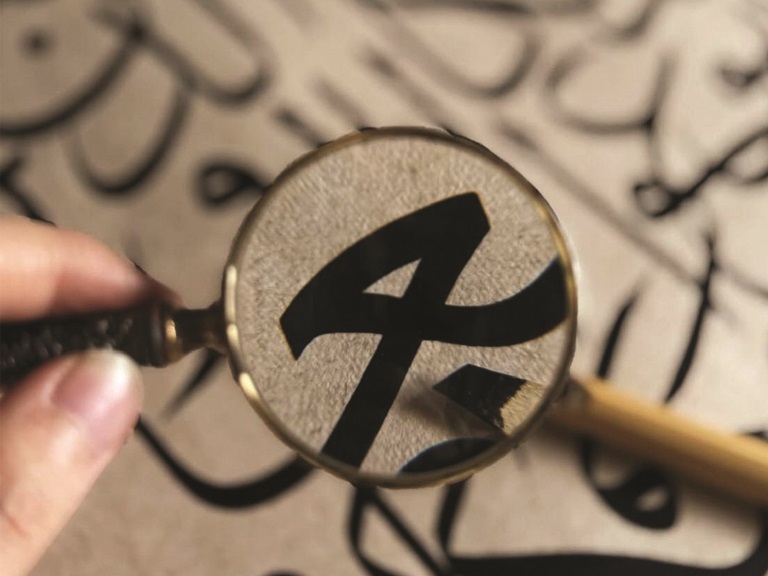
The Master Calligrapher is not merely a calligrapher with a skilled hand, but rather a figure who embodies a union of profound artistic mastery and rigorous pedagogical methodology. He is the bridge between the past and the present, bearing the responsibility of safeguarding an artistic legacy and transmitting it faithfully and sincerely to new generations. His identity is formed from three fundamental pillars: mastery of knowledge, possession of a methodology, and embodiment of ethics.
The First Pillar: Mastery of Science and Art (The Certification)
The Master Calligrapher is first and foremost an expert thoroughly proficient in the principles, geometric, and aesthetic rules of calligraphy. He cannot presume to teach unless he has traversed a long path of study and training under the supervision of his own master:
-
Bearer of Certification and License: In the traditional custom of calligraphy, a calligrapher only becomes a master after receiving a license (Ijaza) from his teacher. This license is an official certificate attesting to his mastery of the proportions of letters (al-Nuqat) and the rules of composition, granting him the right to transmit this knowledge. This connection ensures the continuity of the chain of transmission and preserves the rules from distortion.
-
Dissection of the Letter: He is not merely an imitator, but a visual analyst. The Master Calligrapher knows the anatomy of each letter (al-Tasharih), can identify the source of a student’s error, and is capable of explaining the specific rule that was breached with mathematical and artistic precision.
-
Comprehensive Knowledge: He possesses a broad calligraphic culture encompassing the history of scripts, their origins, their different schools (such as the Ottoman, Baghdadi, Egyptian, and Levantine schools), and the biographies of their eminent masters, lending his lessons historical and artistic depth.
The Second Pillar: Pedagogical Methodology (The Art of Teaching)
The difference between a skilled calligrapher and a Master Calligrapher lies in the ability to transmit knowledge. Teaching is a distinct art requiring additional skills:
-
The Ability for Effective Correction (al-Tawshih): It is not enough for the master to write beautifully for the student to see; he must be able to see the error that the student himself does not see, and provide a clear, justified correction (tawshih) that guides the student to the precise point needing adjustment.
-
Simplification and Gradual Progression: He possesses a clear methodology that begins with teaching individual letters, then their combination, then writing sentences, then complex compositions. He can deconstruct difficult rules into simple steps that a beginner can comprehend.
-
Patience and Motivation: Calligraphy is a long and slow journey, and the Master Calligrapher is endowed with forbearance and patience for repetition. He understands that constant encouragement is the key to keeping the student on the path of practice.
-
Methodological Flexibility: He is capable of adapting his teaching style to suit varying student levels, taking into account individual differences in learning and mastery.
The Third Pillar: Ethical and Spiritual Qualities (The Etiquette of Calligraphy)
Arabic calligraphy is a spiritual art, and the Master Calligrapher is a promoter of its etiquette and ethics:
-
Trustworthiness and Integrity: He is committed to transmitting knowledge honestly without concealing any details or artistic techniques. This trustworthiness is the foundation of the relationship between master and disciple.
-
Humility (Good Manners): Despite his skill, the Master Calligrapher remains humble, a lover of knowledge, who respects his own teacher and respects his students, reflecting the etiquette of the art in his behavior.
-
The Good Example: He is a role model in his commitment to practice, in the way he handles his tools, and in his appreciation for other arts. He teaches the student not only how to write, but how to be ethical and contemplative.
The Master Calligrapher is a guardian of a rich civilizational heritage. He transforms the letter from a mere tool of communication into an immortal work of art. His mission is not merely to decorate paper, but to instill in his students’ souls the values of beauty, commitment, and discipline. Therefore, the Master Calligrapher always remains the living extension of the greatest arts of the Islamic nation.